
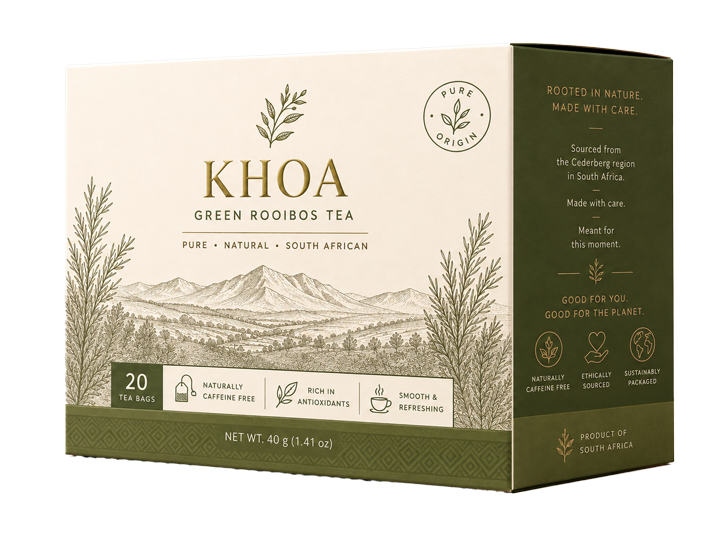
Khoa Green Rooibos
Green Rooibos from South Africa
Green Rooibos is a lighter, less oxidised form of rooibos with a fresh, delicate taste and subtle grassy notes. Naturally caffeine-free, it produces a clean, refreshing cup with a pale-golden colour.
Origin
Cederberg, Western Cape, South Africa
Caffeine
Naturally caffeine-free
Brewing
80-90 C · 3-5 minutes
Green Rooibos vs traditional Rooibos
Both varieties come from the same South African plant, Aspalathus linearis, and are naturally caffeine-free. Traditional Rooibos undergoes oxidation, developing a rich amber-red colour and a smooth, rounded taste.
Green Rooibos is processed to limit oxidation, giving it a lighter colour and a fresher, more delicate flavour. It is best brewed at a lower water temperature for a shorter time.
What does Green Rooibos taste like?
| Profile / Method | Description |
|---|---|
| Taste profile |
Light, fresh and delicate, with subtle grassy, herbal and mildly sweet notes. Cleaner and crisper than traditional Rooibos, with a gentle, refreshing finish. |
Preparation
How to brew Green Rooibos |
|
| 01 · Hot Hot preparation |
Use water heated to 80–90°C and steep for 3–5 minutes. Enjoy plain to appreciate the delicate flavour, or add a little honey or lemon to taste. |
| 02 · Cold Cold preparation |
Brew Green Rooibos in 80–90°C water for 3–5 minutes. Remove the tea, allow the infusion to cool, then refrigerate. Serve chilled or over ice. |
Cederberg · Western Cape · South Africa
Origin
Green Rooibos from the Cederberg
Green Rooibos comes from Aspalathus linearis, a plant indigenous to South Africa and closely associated with the Cederberg region of the Western Cape.
The region’s landscape and rooibos-growing heritage are central to the story KHOA aims to tell about this distinctive South African infusion.
Wholesale
Looking for Green Rooibos for your market?
KHOA welcomes enquiries from retailers, distributors and commercial partners interested in Green Rooibos. Canada is the initial target market, with other opportunities considered according to product availability and local requirements.