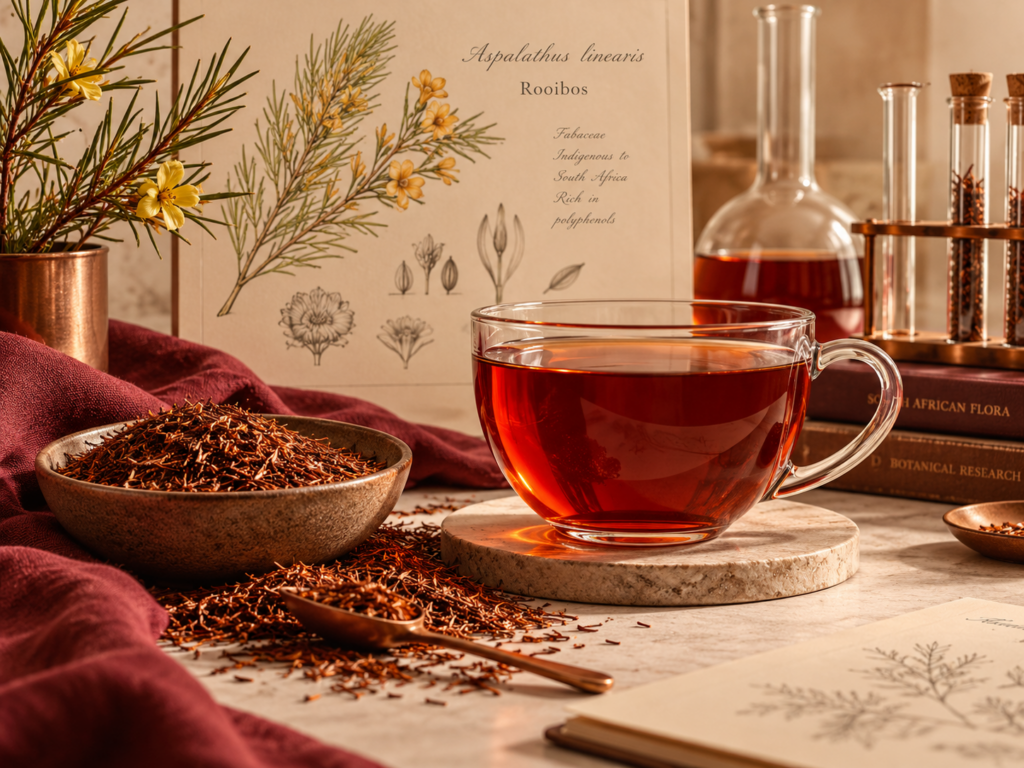
What Cardiovascular Research Has Examined
Rooibos has also been investigated in relation to cardiovascular biomarkers.
In one study led by Professor Jeanine Marnewick at Cape Peninsula University of Technology, 40 adults considered at risk for cardiovascular disease consumed six cups of fermented rooibos each day for six weeks. The Science of Rooibos
Researchers measured a range of biochemical markers, including oxidative stress indicators and blood lipids. The study reported changes in several of these measurements after the rooibos intervention. PubMed
Another study looked at angiotensin-converting enzyme, usually shortened to ACE.
Seventeen healthy volunteers consumed a single 400 ml serving of rooibos. Researchers recorded temporary inhibition of ACE activity at 30 and 60 minutes after consumption. The Science of Rooibos PubMed
Again, the important word is temporary.
This does not establish rooibos as a treatment for high blood pressure or cardiovascular disease. The study measured a biological response under specific experimental conditions.
That is very different from demonstrating a clinical treatment effect.
Can Rooibos Compounds Be Absorbed by the Body?
Another useful question is whether the compounds researchers identify in rooibos simply remain in the cup, or whether some of them can actually be detected after consumption.
A crossover study involving 12 healthy men investigated beverages made from unfermented rooibos.
Researchers identified metabolites associated with the rooibos compounds aspalathin and nothofagin in blood and urine after participants consumed the rooibos preparations. The Science of Rooibos
The published study identified several metabolites and detected some rooibos-derived flavonoids following consumption. PubMed
That provides evidence that at least some rooibos polyphenols can be absorbed and metabolised by the human body.
It still does not tell us that absorption automatically results in a particular long-term health outcome.
Red Rooibos and Green Rooibos Are the Same Plant
Red rooibos and green rooibos are not different species.
Both come from Aspalathus linearis.
The difference is mainly what happens after harvesting.
Traditional red rooibos undergoes oxidation during processing. This contributes to the familiar reddish colour and smooth, naturally sweet flavour associated with conventional rooibos.
Green rooibos is processed in a way that limits oxidation.
That difference in processing also changes the polyphenol profile of the finished product. The Science of Rooibos
Research has found differences between fermented and unfermented rooibos, including differences in antioxidant composition.
What the current human evidence does not establish is that one should be described as clinically healthier than the other. Both forms have demonstrated antioxidant activity in human research. The Science of Rooibos
So the more useful distinction for most tea drinkers is not simply “healthy versus healthier.”
It is that different processing produces different chemical profiles, colour and flavour characteristics.
What Does the Science of Rooibos Actually Tell Us?
There is genuine scientific interest in rooibos.
Human studies have investigated antioxidant activity, oxidative stress markers, cardiovascular biomarkers and the absorption of rooibos polyphenols. Broader research has also explored inflammation, glucose metabolism and metabolic health. The Science of Rooibos
But the evidence needs to be kept in perspective.
Many published rooibos studies are still based on laboratory or animal models, while the body of larger and longer-term human clinical research remains comparatively limited. The Science of Rooibos
That is why we prefer the simpler conclusion.
Rooibos is a distinctive South African herbal beverage with an interesting and growing body of research behind it.
The science is worth following.
It does not need to be exaggerated.
Research Referenced in This Article
Abdul, N.S. & Marnewick, J.L. (2023)
What has been the focus of Rooibos health research? A bibliometric overview.
Journal of Herbal Medicine, 37, 100615. DOI: 10.1016/j.hermed.2022.100615. The Science of Rooibos ScienceDirect
Marnewick, J.L. et al. (2011)
Effects of rooibos (Aspalathus linearis) on oxidative stress and biochemical parameters in adults at risk for cardiovascular disease.
Journal of Ethnopharmacology, 133(1), 46-52. DOI: 10.1016/j.jep.2010.08.061. The Science of Rooibos PubMed
Villaño, D. et al. (2010)
Unfermented and fermented rooibos teas increase plasma total antioxidant capacity in healthy humans.
Food Chemistry, 123, 679-683. DOI: 10.1016/j.foodchem.2010.05.032. The Science of Rooibos ScienceDirect
Breiter, T. et al. (2011)
Bioavailability and antioxidant potential of rooibos flavonoids in humans following the consumption of different rooibos formulations.
Food Chemistry, 128(2), 338-347. DOI: 10.1016/j.foodchem.2011.03.029. The Science of Rooibos PubMed
Persson, I.A.L. et al. (2010)
Effects of green tea, black tea and Rooibos tea on angiotensin-converting enzyme and nitric oxide in healthy volunteers.
Public Health Nutrition. DOI: 10.1017/S1368980010000170. The Science of Rooibos PubMed
Scientific information in this article is provided for educational purposes only. Rooibos is a food and beverage product and is not intended to diagnose, treat, cure or prevent disease. Research findings discussed above relate to the specific study conditions and populations examined. The Science of Rooibos